Support connection. Share lived experience. Help shape a new model of menopause support.
I am currently recruiting peer facilitators with lived experience of menopause to support a virtual peer support program. This role is part of a Research Ethics Board (REB#26-112 Approved) study focused on co-designing a virtual menopause peer support program developed in collaboration with people who have lived experience of menopause and subject matter expertise.
Although menopause is a common life transition, many people navigate it without opportunities for meaningful connection, reflection, or support. This study explores how a structured virtual peer support program can help reduce isolation, foster connection, and support individuals through perimenopause, menopause, and postmenopause.
Peer facilitators play a key role in supporting the creation of these spaces. They help hold a structured, supportive environment where participants can share experiences, learn from one another, and connect across different backgrounds and locations. This is not a clinical role. It is a peer-based, relational role grounded in lived experience.
What peer facilitators will do
Co-facilitate a virtual peer support group.
Support structured, guided group conversations.
Encourage inclusive participation and respectful dialogue.
Help create a safe, supportive, and confidential group environment.
Participate in facilitator training and ongoing debrief sessions with the research team.
Peer facilitators do not:
- Provide medical advice or clinical support
- Act as therapists or counsellors
- Diagnose, interpret, or treat symptoms
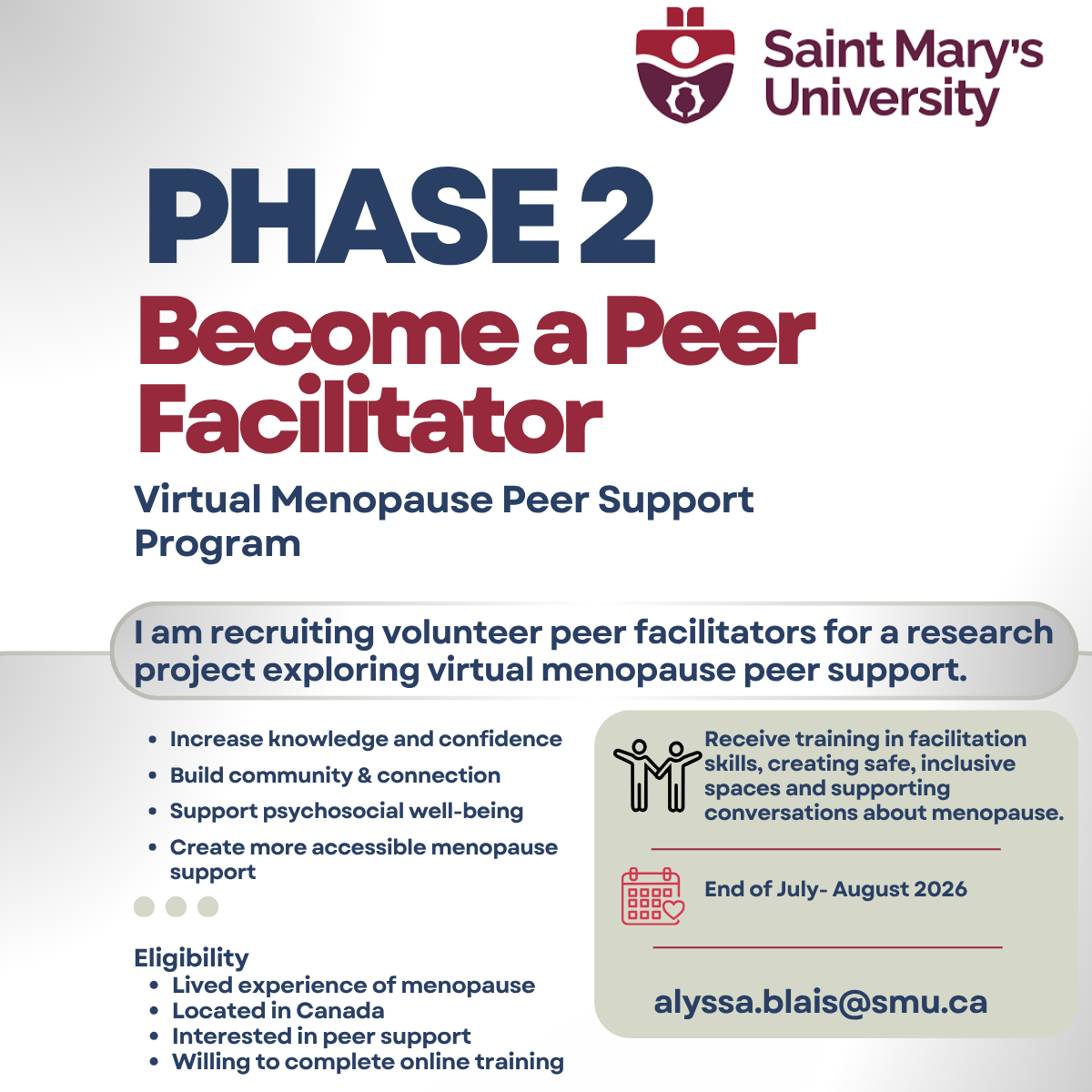
Want to become involved?
You may be a good fit for this role if you:
- Have lived experience of menopause, or postmenopause
- Are comfortable participating in virtual group spaces
- Are interested in supporting others through shared experience
- Value listening, reflection, and connection
We welcome facilitators from diverse backgrounds, including rural communities and individuals of different genders and identities (cisgender women, transgender men, non-binary, and gender-diverse people).
All peer facilitators will receive:
- Structured facilitator training prior to the program
- A facilitator guide with weekly session outlines and prompts
- Ongoing support throughout the pilot program
- Opportunities for reflection and debrief with the research team
This role is designed to be supported. You do not need prior facilitation experience.
Facilitator Training: Approximately 6–8 hours delivered virtually over several sessions.
About the Project
This study is co-designing and testing a virtual menopause peer support program developed with people who have lived experience of menopause and subject matter expertise.
The program includes:
- a structured peer support model
- training for peer facilitators with lived experience
- a pilot group to explore feasibility, acceptability, and impact
The goal is to develop an evidence-informed, inclusive, and adaptable model that can be used in community and health settings.
Principal Investigator
Alyssa Blais, Master’s Student, Applied Health Services Research, Saint Mary’s University Email: alyssa.blais@smu.ca
Faculty Supervisor
Dr. Michele Byers, Faculty of Arts, Women and Gender Studies, Saint Mary’s University Email: michele.byers@smu.ca